For Editor House Facility, Kenyan author and socialist Shiraz Durrani writes about the profound difficulties of radical and socialist publishing in the context of class, capitalism, and imperialism in Africa. Independent publishing of nonconformist and critical fiction and nonfiction is fighting for its life across the continent. Durrani unpicks the issues and proposes some solutions.
By Shiraz Durrani
The political context of African publishing is not given the attention it deserves. The elephants in the room are capitalism and imperialism which distort every aspect of life in favour of the ruling elite and ensures policies that are against the interest of working people. Essentially, there are class divisions and class struggle in Kenya (and Africa). It is the capitalist ideology that the ruling class promotes while suppressing the socialist aspirations of people. Thus, the power relations are also distorted as the ruling class controls state power (political, economic, military, government policies, police) with the support of imperialism. They use their power to suppress any attempts for equality and justice in society. This includes the suppression or lack of support for the independent publishing sector whose existence itself is made difficult by these political factors. We need to be mindful of Marx’s correct assertion, ‘the ruling ideas of society are the ideas of the ruling class.’ This explains why radical and socialist publishing is permanently on the back-foot in Africa and elsewhere.
So, in short, these political factor impacts on the content of publishing. It is easy to publish books that follow the political and opinions set by comprador governments, but anything that questions or challenges government policies comes under immediate (government) attack in many ways. It is particularly difficult to publish historical and political books— non-fiction in general — that reflect working class (and peasant) interests and perspectives. I will explore some of these issues in this blogpost.
Financial independence
These factors affect financial viability and the independence of small, independent publishers. Getting funds from NGOs is one avenue open to them, but then political and social strings are often attached. Yet, without such support, it is only the rich who can afford to publish books, and their perspective frequently reflects their class position. It is particularly difficult for independent publishers as the major global corporations have the resources to capture African publishing markets. In exactly the way they have captured the only profit-making service available to publishing — the school textbook market.
Relevance of publications
Many books published (at least in Kenya) are not relevant to working people and do not support their struggles for equality and justice. The ones that are published and easily available tend to shape the thinking of the readers towards capitalism and support for ruling elites. The needs of workers, peasants, pastoralists, fisher people, the urban and rural poor and unemployed people are neglected. As a result, more fiction —especially romance, detective and similar genres — is generally published than non-fiction as it is often regarded as politically safer. African writers, academics and intellectuals are thus deprived of an avenue to publish their records on history and other subjects.
Language of publication
The issue of relevance is related to the use of language in publishing. The majority is in English, French and Portuguese. Ruo Kimani-Ruo highlights the issue of language. Kiswahili, being the national language of Kenya and Tanzania is now being taught in all schools and in universities in these countries, and needs a fresh stimulus from the publishers in Africa to support its growth and development, not only in Kenya and Tanzania, but also other regions of Africa where the language is now widely spoken and now taught in schools such as in Uganda, Rwanda, Burundi and South Africa. Kiswahili writers’ workshops and symposiums need to be supported with serious and focused funding by the publishers in these countries.
Ruo Kimani-Ruo goes on to argue that publishing of progressive poetry and creative writing collections should receive greater emphasis and support. Institutions related to publishing such as printers, bookshops, and libraries should be promoted and training of editors enhanced. Poets should form a national union of poets to enable young people to participate in the art. Competitions among budding poets should be encouraged.
Activist publishing
The only way relevant books to appear is for publishers to publish outside the profit motive so the books appear based on their political and social commitment for working people and through their support for people’s struggles for justice and equality. This implies that they must support publishing from their own limited resources. This then impacts the quantity of their publication and may impinge on the quality as well.
It is not surprising that important historical and political material — books, pamphlets and periodicals — on Kenya, for example, have been written and published by political movements. For example, Mwakenya’s Draft Minimum Programme (1987) and Kenya: Register of Resistance, 1986 (published in 1987) and Umoja’s Moi’s Reign of Terror: A Decade of Nyayo Crimes Against the People of Kenya’. It is not surprising that few, if any, public, academic or research libraries in Kenya even stock such material. It falls on the independent Ukombozi Library to do so, in its Kenya Resistance Archives (KRA).
Lack of relevant libraries
Another reason that publishing in Africa suffers is because there are no appropriate avenues for books to be made available to actual and potential readers. Public libraries have failed to fulfil their main task of providing relevant material to the working class. Like publishing, libraries have also become victims of the capitalist status quo and provide material often acquired by donations from foreign agencies and embassies. Given the fact that most libraries have retained the colonial, capitalist model of public libraries, access to material relevant to working people, in terms of content, language and class perspectives, is simply not only unavailable in such spaces, but even when available, it is not promoted to working class readers in appropriate ways – take a look at the important volume on Marxism and public libraries by Joe and John Pateman.
Information, knowledge and books
It is not surprising that as entire countries in Africa have been captured by capitalism, their publishing sectors are similarly captured in the interest of hiding facts and knowledge about the damage done by capitalism and about the existence of alternative, socialist societies where rights and working-class power are protected. The key battleground is the capture of minds, influencing the thinking of children and adults, workers and peasants, rural and urban youth in and out of employment.
Such actions from imperialism then help to hide important facts of capitalist economic exploitation and social oppression. Liberating minds then should be the focus of relevant African publishers. The damage done to the awareness of people in Africa about their societies and history enables capitalism to continue its exploitation with minimal resistance. This can be illustrated by three examples of hidden information about individuals and organisations — all in the interest of presenting capitalism as TINA – There Is No Alternative, the capitalist mantra to suppress any radical socialist alternative.
Information suppressed
Let’s look at J. M. Kariuki who was promoted by capitalism as a people-oriented politician who stood for the rights of working people. He was promoted as ‘a man who challenged the status quo’. Yet unknown to most people in Kenya, J M Kariuki was an Israeli’ agent and helped ‘Israel’ to infiltrate the Kenya government with the support of Jomo Kenyatta, the former Prime Minister of Kenya. It is indeed surprising that even though Kenya has one of the most developed publishing industries in Africa, no books were published for decades revealing the true nature of this popular politician who would have lost his standing if facts about his operations were widely known.
Another example is Pio Gama Pinto who was an important socialist politician, trade unionist and a member of Mau Mau for which he acquired arms from South Africa. He was assassinated by agents of the Kenyan government in 1965 and all information about him was suppressed by the government. The numerous publishers in Kenya failed to publish a book on him because of political pressure. It took a small, independent publisher — Vita Books — to publish the first volume on him in 2018.
Finally, we have the Kenya People’s Union (KPU) which was an opposition political party in Kenya from 1966-1969. The organisation advocated for socialism in Kenya, positioning itself in opposition to the governing KANU party. This is the central reason why it was suppressed in 1969 and its leaders were detained. Again, like Pio Gama Pinto, no books were published on the organisations history and policies. It was again for Vita Books, the independent publisher, to publish key information about the party and reproduce the organisations key documents. Vita Books took another step and published a full history of KPU written by Paul A. Ogula in 2025.
African publishers, researchers, academics, historians as well as archives and libraries can rightly be held responsible for not providing people with information that can liberate their minds from capitalist and imperialist prisons.
A model that works – in Kenya
Within the limitations that class, ideology and politics imposes on Kenya, it has been possible to develop a model of an independent publisher and an independent library that meet the information, knowledge, educational and political needs of working people. This is the close relationship between Vita Books and Ukombozi Library. As mentioned earlier, Vita Books has published a number of key books not taken up by any other publisher. It owes its success to publishing material from a working-class perspective and records history and the current state of class in Kenya. But it does not work in isolation: It works closely with Ukombozi Library which does not restrict its activities to the role of the traditional public library (see the chart below). It is not claimed that this model is applicable in other countries in Africa, as each country needs to develop its own methods of ensuring the successful existence of independent publishers and libraries. It remains, however a possible model that could be relevant to other countries.

A model that works — in Africa
In the last few years, many countries in Africa have seen intensified resistance to imperialism and capitalism led by younger generations who have proclaimed loudly, Tunakataa! (“We Refuse/We Say No’” in Kiswahili). But publishing in Kenya has not yet liberated itself, as Stephanie Kitchen – who runs the brilliant African Books Collective – (explained earlier this year:
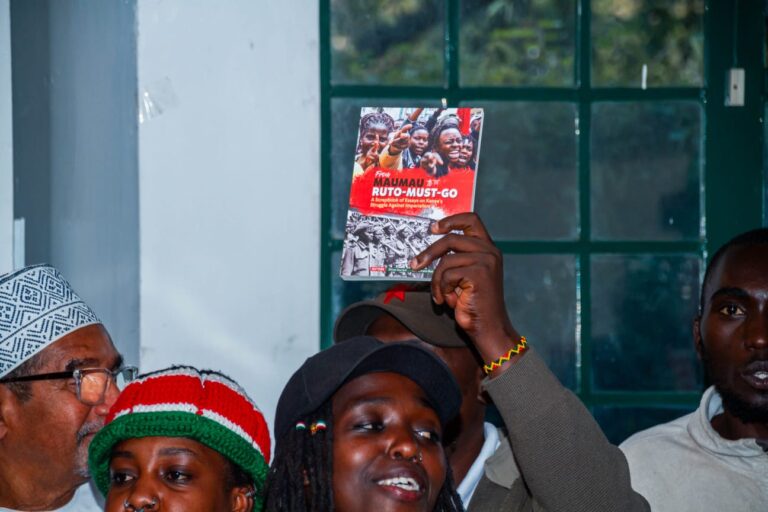
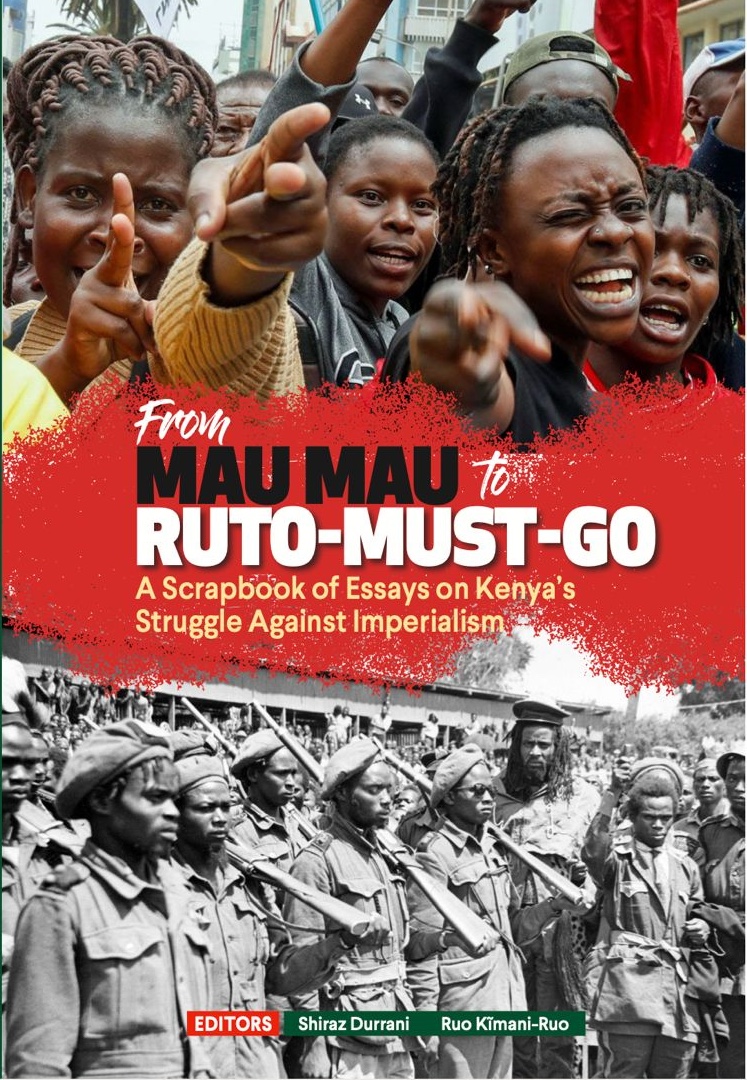
Durrani wrote to me in the summer of 2025 about three failed attempts to publish his edited manuscript From Mau Mau to RutoMustGo, a collection of essays set in a radical historical context. Durrani writes that ‘it is now clear that there is no publisher in Kenya who can publish this book. If these [progressive, independent, community] publishers can’t do it, then I don’t think any other publisher will go near it.
In conclusion, it is clear that African publishing is in a capitalist prison with imperialism and comprador governments deciding the future of its people, resources and every aspect of their lives. In this context, if publishing is to be liberated from this deathly grip, it will need to enter the political arena which it has mostly avoided to-date.
It is time that independent publishers join hands with other progressive forces that are in struggle against capitalism and imperialism. There is no neutrality in this struggle. The only way is to join people’s battle for justice and equality. At the same time, independent publishers in each African country need to join hands with, and give and receive solidarity from, their counterparts in other African countries.
International solidarity can also be achieved for African left publishers by joining the International Left Publishers Association. There are many challenges in this approach, but there is no alternative for publishing but by joining people’s struggle for justice and equality. Otherwise, they will remain at the margin of social life.
However, there is a glimmer of hope as there are signs that the recommendation above is being fulfilled in small steps. On Africa-wide cooperation of progressive publishers, Kitchen continues the success story:
But this story has a hopeful ending. The radical Uganda-based publisher Editor House Facility has agreed to publish From Mau Mau to RutoMustGo. Durrani describes this as ‘a great victory for progressive and socialist aspiration of Pan-Africanism as political boundaries are wiped out in extending support from Uganda to Kenya’. Progressives in East Africa are resisting censorship and attacks on their academic and political freedoms.
Such developments point to a new dawn in progressive publishing in Africa. They have the potential to bypass imperialist and capitalist traps and link progressive and left publishing movements across Africa. Small beginnings can have revolutionary ends.
Time will tell!
Shiraz Durrani is a British-Kenyan library science professional and author known for his contributions to the social and political dimensions of information and librarianship. His work often focuses on the intersection of information, politics, and liberation struggles, particularly in the context of Kenya and the broader anti-imperialist movement.
Featured Photograph: Books from Somaliland at the Hargeisa Book Fair in 2019.