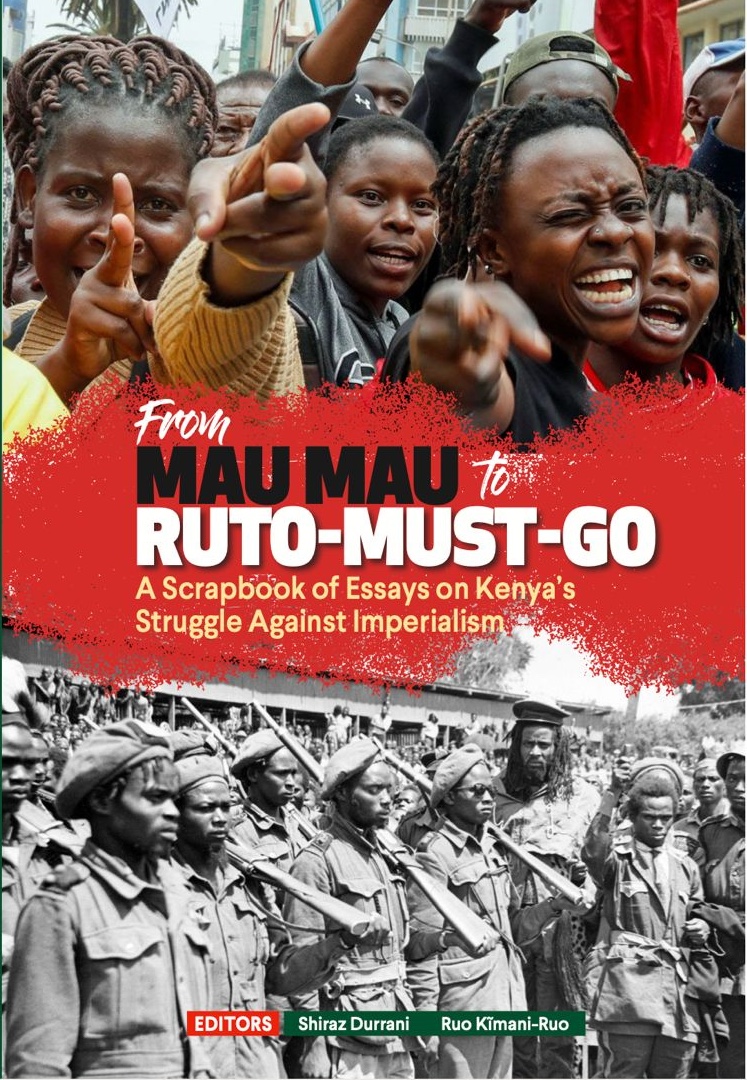
Recently published by Editor House Facility, From Mau Mau to Ruto Must Go edited by Shiraz Durani and Ruo Kimani-Ruo, brings together a broad range of essays and analysis that covers Kenya’s long resistance to British colonialism, and the post-independent struggles for liberation and freedom. Activists and writer, Gathanga Ndung’u celebrates in this blog a volume that provides a unique record of current events, with relevance not only in Kenya but also across Africa and the Global South, but he also tells the story of how the authorities tried to stop the book from reaching its audience.
By Gathanga Ndung’u
From Mau Mau to Ruto Must Go is a compilation of essays written from the 2024 and 2025 youth uprisings in Kenya. It is a chronicling of events, a synthesis of actions and reactions, and the analysis of the historical, political, socio-economic, and cultural undercurrents informing the tensions preceding and during the protests. The book was a patchwork, produced in the trenches of the youth uprisings.
From Mau Mau to Ruto Must Go is an intergenerational continuum of resistance. It is a conversation between the old and the new; it is the passing of the final baton (the third), with the first being the street struggle and the second the cultural resistance. This book completes the handover of ‘all the tools’ needed for the third liberation struggle. In the ‘battlefield’, the baton was passed from the Mau Mau to the youths when the Mau Mau remnant women from Mathare – Kenya’s oldest slum with a population of more than half a million – held the first protests against evictions in May 2024, just after the devastating floods, and which was followed by the youth uprisings in June of the same year. Through these symbolic acts, the paraphernalia of resistance had been passed from the old generation to the younger generation.
In 2025, the relay of the baton of cultural resistance happened when the original cast of Kamirithu – a decolonial theatre launched in 1976 by local workers and peasants, with the radical writer Ngũgĩ wa Thiong’o – organized a re-enactment of one of their plays with the younger Social Justice Centres Traveling Theatre, while they directed it to fit the original play. This signified the handing over of the mantle of cultural resistance to the generation of social justice thespians. With the writing of this book and its completion in 2026, the intellectual handover of the symbolic pen from the older generation to the younger generation has also been achieved. These three-stage handing-over rituals- street-level resistance, cultural struggle, and intellectual struggle- have completed over the transition of the struggle to the young, who must, from now on, lead the third liberation.
For long, Kenya has endured repressive regimes and a state that is increasingly becoming a neo-colonial foot soldier. This has necessitated a struggle to liberate the country from the clutches of a corrupt local comprador class and global imperialist forces. Through the collusion of these actors, the aspirations of the people were forgotten and replaced with imperialist interests that continue to be diametrically opposite to the dreams of most Kenyans.

When ideas become too dangerous – the struggles to publish and distribute
The East African Community is rapidly sliding into an abyss of dictatorship. The Jumuiya (community) envisaged at the establishment of the East African Community in 1967 was to guide us to full political, cultural and socio-economic integration. However, the current crop of leaders has only managed to build a closely-knit club for East African dictators: William Ruto of Kenya, Samia Suluhu of Tanzania, Kaguta Museveni of Uganda and Paul Kagame of Rwanda to cooperate for effective repression of their citizens. While there is free movement for the political elites, they have still maintained colonial borders, and many stumbling blocks to separate the people from ever fully integrating. Their stay in power has been ensured by the balkanization of our states, which weakens the building of collective power and solidarity in the region.
This is the backdrop to the ongoing repression. We knew what lay ahead for the publishing, launching, and stocking of From Mau Mau to Ruto Must Go. From the publishing of the book to the stocking and the launch, this book has already had its fair share of challenges. The process has been one full of fear, tension, intimidation, but also one full of courage and determination. After months of compiling our voices through the essays, proofreading, and editing, the first manuscript was ready for publishing and printing with the Ugandan based pan-African publisher Editor House Facility.
Kenya, long celebrated as one of the region’s countries with an expanded democratic space and a vibrant tradition of progressive activism, was the last place we expected our book to be treated as seditious material. Such censorship seemed reminiscent of the Moi era, when critical literature was routinely proscribed and suppressed. The title scared every potential publisher in the country, and comrades, and even some safe spaces, which we knew could provide a home for the book. We got many suggestions from different quarters to revise the manuscript title to From Mau Mau to Gen Zs or a less problematic title. Various justifications were given for why it was a bad idea to proceed with the current title. Some saw this as a blatant invitation to target activists, and others felt the state would interpret the title or use it to crack down on progressive forces.

As a contributor and one of the people who were involved in the various processes, I knew that the title came with its fair share of risks and burdens to shoulder, but we were all ready for it. To us, ‘Ruto Must Go’ was not just a slogan or a fleeting chant but a movement that understood what Ruto or Rutoism represented. Ruto Must Go meant death to the system whose image is mirrored in Ruto’s Presidency. It means uprooting the more than 60 years of foundations of the colonial-neocolonial state. It also represents the abolishing of state capture, misgovernance, deep-rooted corruption, greed, and neocolonial servitude. Through the book, Ruto is an epitome of what African youths are loudly rejecting. Due to these reasons, we chose to remain with our bold and daring title.
In Kenya, we failed to secure a publishing house, and no one seemed interested in supporting the book in any way. This partly explains the long period it took to publish the volume. Luckily, from the most unlikely corner of the growing, ferocious East African ‘Dictatorship States’, we found an oasis of intellectual refuge and solidarity in Uganda, through the Editor House Facility. After the publication of the book, 300 copies were printed, and the first 200 copies were dispatched to Kenya at the end of May 2026. Our launch, which was to coincide with 1 June Madaraka Day Celebration – a celebration of self-governance from the British Government in 1963 – failed to take place as we learnt a few days later that the books were confiscated at the Kenya-Uganda Border.

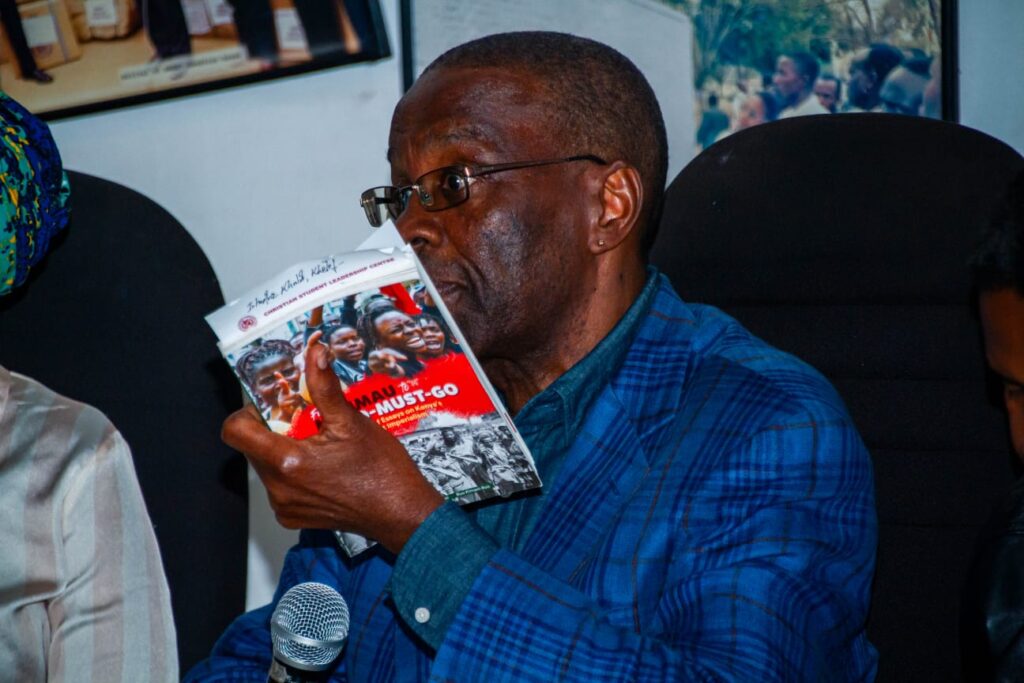
To date the authorities have failed to release the books and have refused to give any comments on their reasons. The driver of the bus company contacted us and described how he was interrogated and told that the books were illegal in Kenya. He was full of fear after being interrogated aggressively for a long period at the border. Through other covert means, we managed to get 55 copies through the border and later, 45 copies. After we got the copies, we hoped to get the help of some progressive libraries and spaces to help with stocking and distribution, but they distanced themselves. Luckily, we managed to get Mathare Social Justice Centre (MSJC) as our first outlet and distributor and the anchor partner in planning for resource mobilization for the launch which was also supported by Comrade Shiraz Durani, who worked tirelessly through all the stages of the book to see its success. Nuria Bookstores and Cheche Bookshop also agreed to stock and distribute the book despite the growing intimidation and the risks it could have brought to them.
For the launch, we had planned a three-series launch, with the first one happening in Mathare to introduce the book to the community, another session at the Cheche Bookshop, and the last and main event in Nairobi’s central business district.
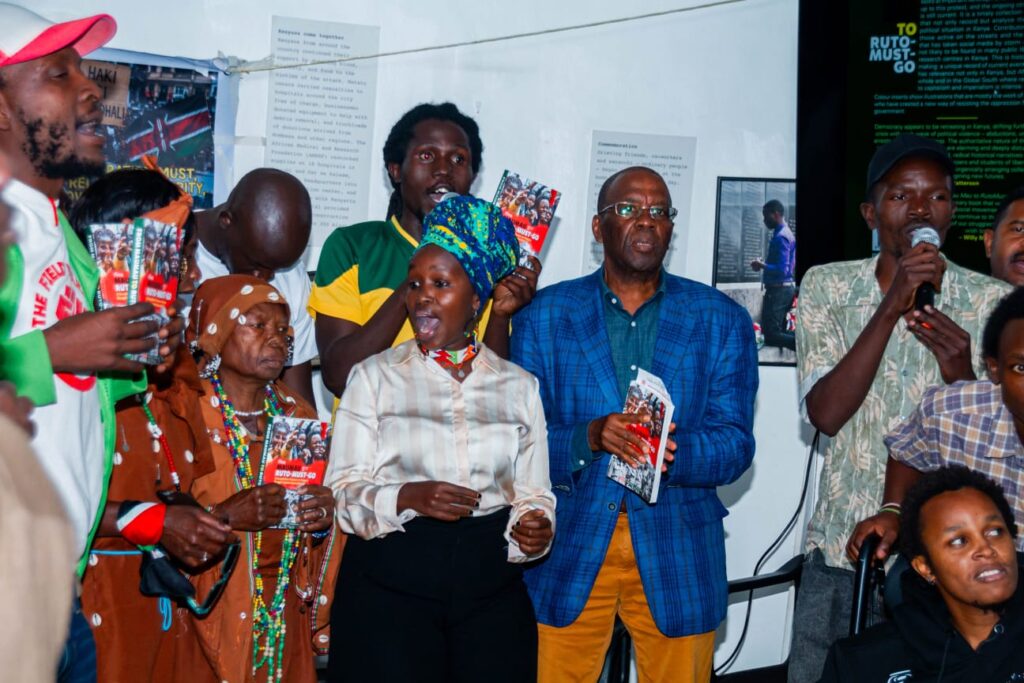
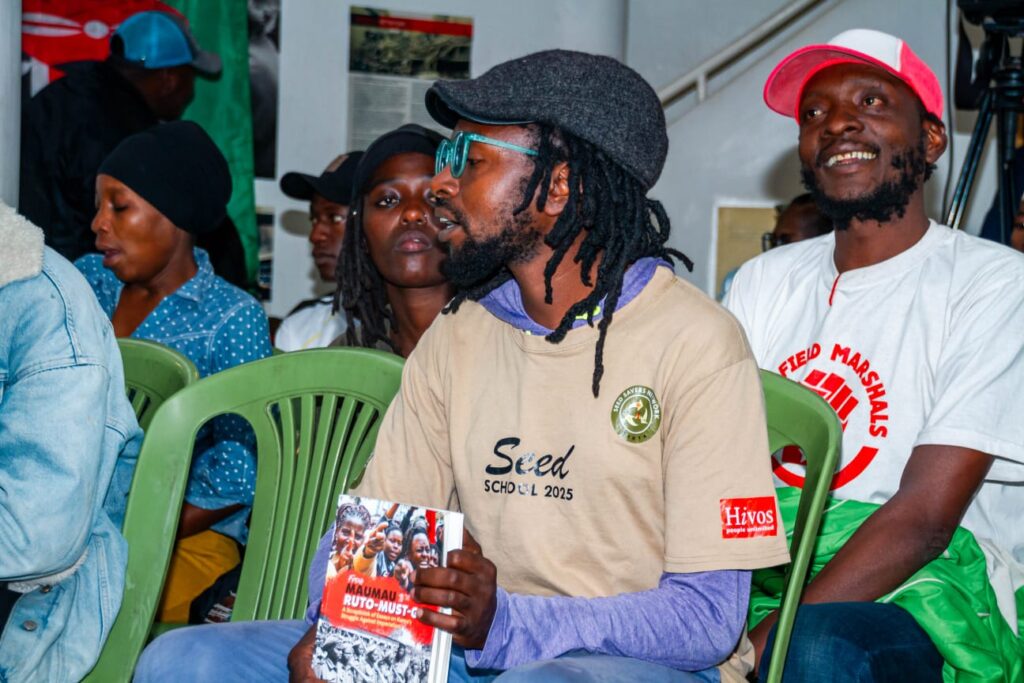
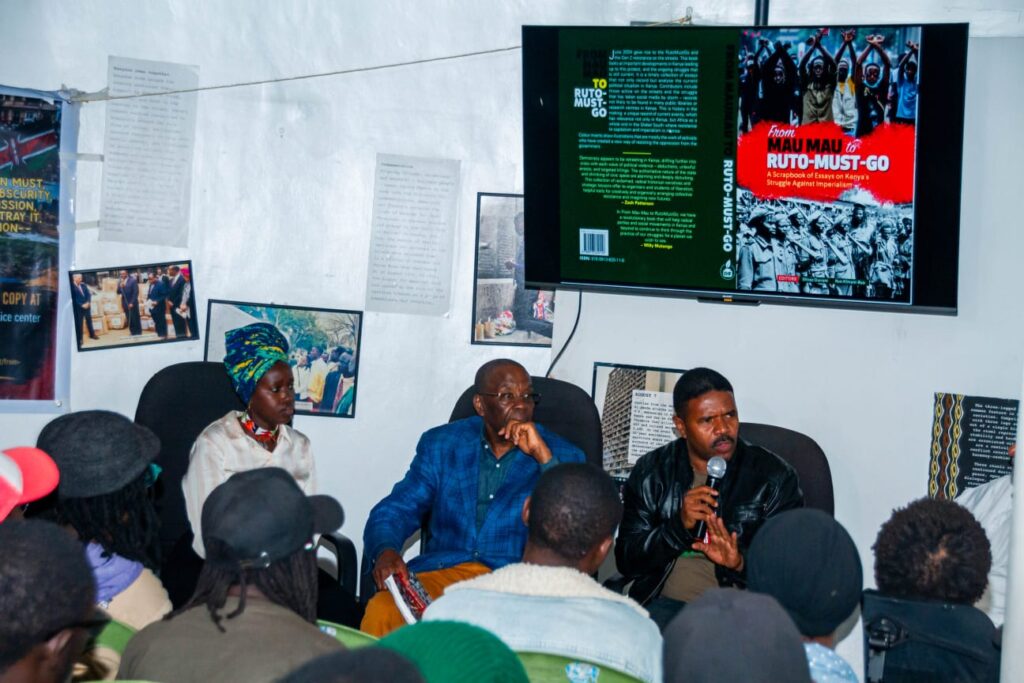
In Mathare, the host of the venue was called multiple times from the police station, informing him to call off the launch, after the poster was shared widely. The coordinator for Ghetto Foundation and the host, Samuel Kiriro, was summoned to the police station on the eve of the first launch. On the same day, several armed police officers stormed the Mathare Social Justice Centre (MSJC) offices. Even though they never arrested anyone or asked for the book, they interrogated our staff while they keenly scanned through the bookshelves. This was done to intimidate the staff and the community before the main launch. Despite all these measures, members of the community came out in large numbers – more than we had anticipated. To avoid disruption on the launch day, the main gate leading to the hall was closed to deny entry to civilian-clothed police officers who had kept an eye on the launch area the whole day. Community members used a hidden entrance, outsmarting the police who awaited them at the main gate.

Despite the best efforts of the state, the event went on smoothly.
The Cheche launch, which focused on activists and writers, took place without any challenges. For the main launch, we were denied several venues, such as the smaller venue at the Kenya National Theatre – Ukumbi Mdogo – because of the book’s title. This happened with other spaces too, as they feared a crackdown by the state. We managed to get to August 7thBomblast Memorial Park, a park named in commemoration of the 1998 US Embassy bombing in Nairobi. With the booking of this venue, the details of the booking were not revealed as it would have caused another cancellation.

This book launch went well despite the presence of plain-clothed sleuths who loitered around the venue, and at one time, came into the venue wanting to gather information about the launch. Also, mainstream media that were invited failed to arrive fearful of the possible ramifications, and the one media house that came, never aired the launch. As a result, we turned to activists and community journalists using the social media pages to spread the news about the ‘new gospel’ in town.
All these aside, From Mau Mau to Ruto Must Go has been launched, enabling the successful documentation of history by the people.
Way forward
With access to the book still limited, we are planning a series of engagements in the coming months to allow for a wider reach. This will be through the use of the Social Justice Centre’s Travelling Theatre to develop scripts from the different issues in the book and develop skits for use in different communities. We will also hold university forums to make sure the institutions of higher learning, which were once the voice of reason and organizing, get the needed inspiration to play their role again. Also, we shall have public reading sessions in different parts of Nairobi, especially around areas where people gather in the central district, such as Uhuru Park, Jevanjee Garden, which is the home for Bunge La Mwananchi – People’s Parliament – at the Kimathi Statue, Tom Mboya Statue – National Archives – among other spaces. We are also planning to have intergenerational dialogues with older progressive individuals on the Kenyan left, as a way of learning and enriching our ideas. Lastly, we are planning to use the Social Justice Band and Truth and Justice Ministry to organize open-air political crusades.
From the streets was this book born, and to the streets shall it return.
In memory of Ruo Kimani Ruo and all the heroes of the 2024-2025 youth uprisings in Kenya.
Gathanga Ndung’u is a community organizer and activist with Mathare Social Justice Centre and a writer with the Kenya Organic Intellectuals’ Network.